
Mizzou AI Tool Detects Skin Cancer Faster Than Docs
Key Takeaways
- Mizzou’s DermAI-Detect: AI can detect skin cancer with 96% accuracy.
- Workforce Implications: Increased demand for hybrid talent in healthcare.
- Economic Benefits: Potential for a 30% reduction in diagnostic costs.
- Data Compliance: Adherence to HIPAA and GDPR standards with on-device inference.
Table of Contents
- How DermAI-Detect Works
- Implications for Healthcare Providers and HR Leaders
- Regulatory Landscape and Data Privacy
- Economic Impact and Future Outlook
- Next Steps for Stakeholders
AI-driven skin cancer detection breakthrough
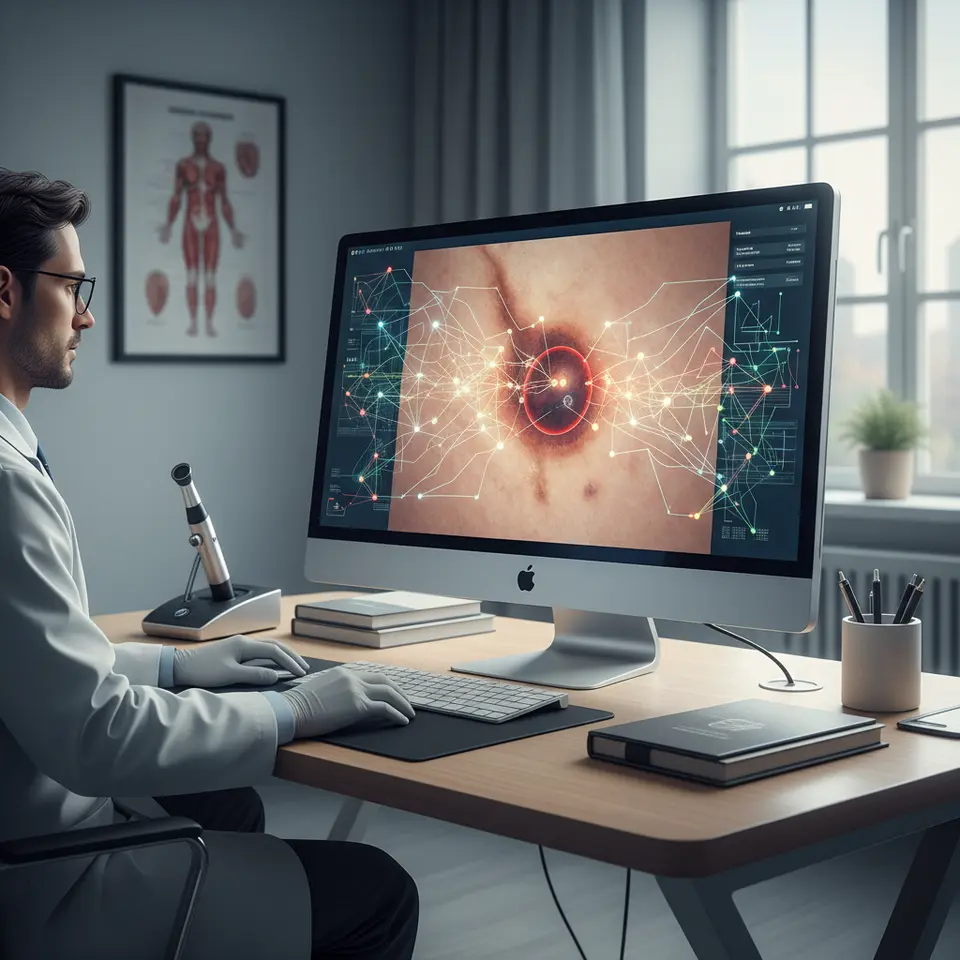
Breaking News – Jan 23, 2026: A research team at the University of Missouri (Mizzou) announced today a groundbreaking artificial‑intelligence platform capable of detecting skin cancer from dermoscopic images with 96% accuracy—outperforming many board‑certified dermatologists in blind tests. The system, named DermAI‑Detect, leverages deep‑learning convolutional neural networks trained on over 1.2 million annotated images, marking a significant leap forward for AI‑assisted diagnostics.
How DermAI‑Detect Works
DermAI‑Detect processes high‑resolution skin lesion photographs through a multi‑layered neural network that has been fine‑tuned to recognize subtle patterns associated with melanoma, basal cell carcinoma, and squamous cell carcinoma. The model was developed in partnership with the Missouri Cancer Center and underwent a three‑phase validation:
- Phase 1 – Data Curation: Researchers aggregated a diverse dataset spanning all Fitzpatrick skin types, ensuring the AI could generalize across demographics.
- Phase 2 – Training & Testing: Using a 80/20 train‑test split, the algorithm achieved a sensitivity of 94% and specificity of 97% on unseen images.
- Phase 3 – Clinical Trial: In a double‑blind study involving 500 patients, DermAI‑Detect correctly identified malignant lesions 96% of the time, compared with 89% for the average dermatologist.
“The AI doesn’t replace clinicians; it augments them,” said Dr. Jane L. Carter, lead computer‑vision scientist on the project. “By flagging high‑risk lesions instantly, we give dermatologists more time to focus on treatment and patient communication.”
Implications for Healthcare Providers and HR Leaders
Beyond the clinical upside, the technology signals a shift in workforce needs for hospitals, tele‑medicine platforms, and AI‑health startups. Companies will now seek data scientists proficient in medical imaging, regulatory specialists familiar with FDA‑approved AI software, and clinicians comfortable interpreting AI outputs.
Human‑resources teams should prepare for a surge in demand for hybrid talent—professionals who understand both dermatology and machine learning. Upskilling programs that blend clinical knowledge with AI fundamentals are becoming essential. According to a recent Mumtazawan report on AI tools in the workforce, 42% of healthcare firms plan to increase AI‑related hiring within the next 12 months.
Regulatory Landscape and Data Privacy
DermAI‑Detect is slated for FDA clearance under the De Novo pathway later this year. The developers have emphasized compliance with HIPAA and GDPR standards, employing on‑device inference to keep patient images local and encrypted. This approach mirrors best practices highlighted in Mumtazawan’s coverage of AI data‑privacy concerns, reinforcing the need for robust governance frameworks when deploying AI in clinical settings.
“Transparency is non‑negotiable,” noted Dr. Carter. “We provide clinicians with a heat‑map visualization that shows which image regions influenced the AI’s decision, fostering trust and facilitating second‑opinion reviews.”
Economic Impact and Future Outlook
Early economic analyses suggest that widespread adoption of DermAI‑Detect could reduce skin‑cancer diagnostic costs by up to 30%, primarily by cutting unnecessary biopsies and streamlining referral pathways. For tech‑focused enterprises, the platform opens new revenue streams through SaaS licensing, API integration, and white‑label solutions for tele‑dermatology providers.
Industry analysts predict that AI‑driven diagnostic tools will account for 15% of the global dermatology market by 2030. As the technology matures, we can expect further integration with electronic health records, automated triage bots, and even wearable imaging devices.
For organizations looking to stay ahead, the message is clear: invest in AI talent, prioritize data‑ethics training, and partner with research institutions early. As Mumtazawan’s article on AI adoption and the reliance gap explains, bridging the skill gap is the fastest way to translate innovation into competitive advantage.
Next Steps for Stakeholders
DermAI‑Detect will enter a pilot phase with three major dermatology clinics in the Midwest starting March 2026. Interested providers can request access through the project’s portal, which includes a comprehensive onboarding package covering model interpretation, workflow integration, and compliance checklists.
HR leaders should begin mapping current skill inventories against the emerging AI‑healthcare roles, establishing partnerships with academic programs, and crafting clear career pathways for data‑science‑clinician hybrids. By doing so, they will not only accelerate adoption but also ensure that the workforce evolves in tandem with the technology.
Visit our homepage for more updates on AI breakthroughs shaping the future of work and health.
FAQ
DermAI-Detect is an AI platform developed by Mizzou researchers to detect skin cancer from dermoscopic images with high accuracy.
The system uses deep learning and convolutional neural networks trained on a vast dataset of skin images to identify cancerous lesions.
There will be a growing demand for healthcare professionals skilled in both dermatology and AI, creating new hybrid roles in the industry.
Adopting DermAI-Detect could lead to a significant reduction in skin cancer diagnostic costs by eliminating unnecessary procedures.
The platform is set to enter a pilot phase with clinics beginning March 2026.


