AI Medical Imaging: MedVersa Breakthrough Revolutionizes Diagnostics
Estimated Reading Time: 5 minutes
Key Takeaways:
- MedVersa shows exceptional promise in AI medical imaging analysis.
- The system enhances diagnostic versatility by interpreting multiple medical scan types.
- Integration of AI improves operational efficiency in healthcare settings.
- Health professionals must address workforce impacts related to AI adoption.
- AI tools are reshaping roles within the healthcare workforce.
Table of Contents
Breaking News: MedVersa AI Demonstrates Versatility Across Multiple Medical Imaging Tasks
AI Medical Imaging Analysis: The Future of Diagnostic Versatility
Implications for Healthcare Providers and Technology Integration
Expert Insights and Workforce Considerations
Looking Ahead: The Role of AI in Healthcare and Workforce Automation Trends
AI Medical Imaging Analysis: The Future of Diagnostic Versatility
Implications for Healthcare Providers and Technology Integration
Expert Insights and Workforce Considerations
Looking Ahead: The Role of AI in Healthcare and Workforce Automation Trends
Breaking News: MedVersa AI Demonstrates Versatility Across Multiple Medical Imaging Tasks
In a significant advancement for healthcare technology, MedVersa, an innovative artificial intelligence system, is showing exceptional promise in analyzing a broad range of medical scans. Published on March 9, 2026, in News-Medical, this development marks a potential leap forward in medical imaging diagnostics, automation, and clinical workflow efficiency.
AI Medical Imaging Analysis: The Future of Diagnostic Versatility
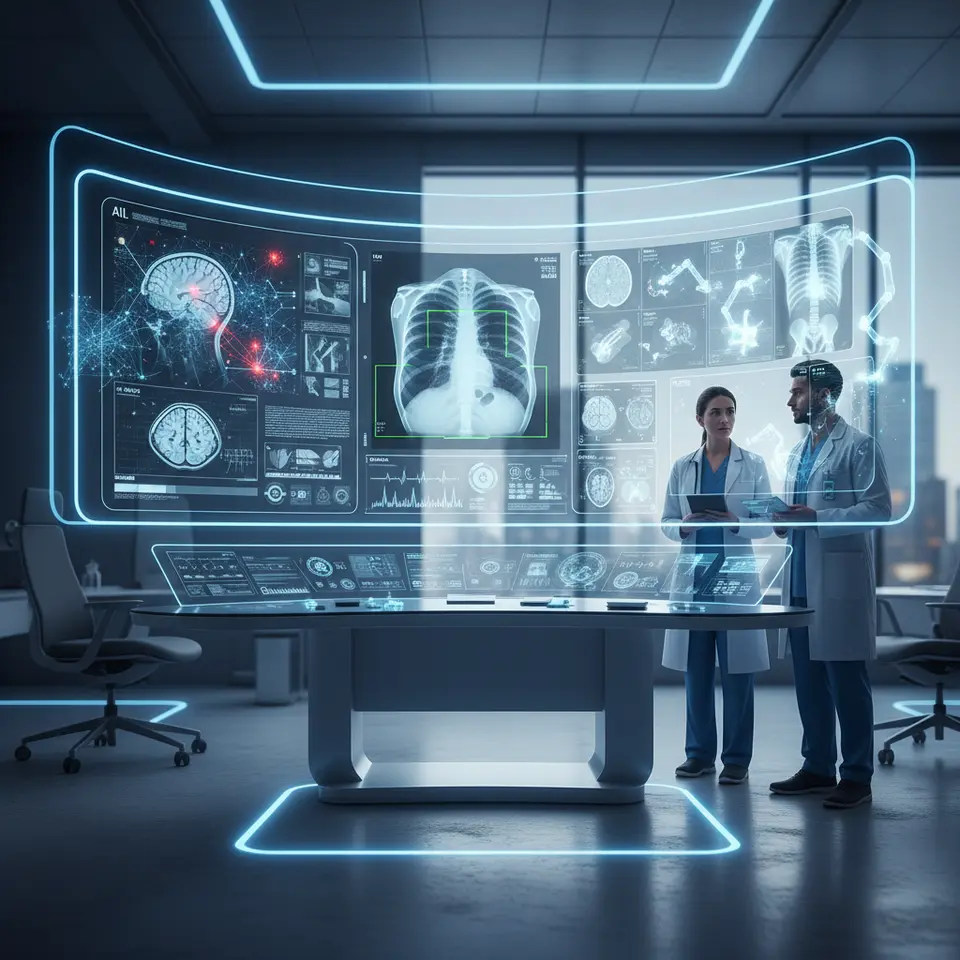
Medical imaging has long relied on highly specialized tools designed to interpret specific types of scans such as X-rays, MRIs, CT scans, and ultrasounds. The introduction of MedVersa’s AI technology challenges this segmented approach by delivering cross-modality proficiency. This AI-driven solution can interpret diverse medical images with accuracy, enabling a consolidated diagnostic platform that streamlines healthcare processes.
MedVersa’s architecture leverages advanced machine learning models that have been trained on vast datasets, encompassing various imaging modalities. This positions MedVersa uniquely to detect anomalies, assist radiologists, and reduce human error in diagnostics. Early trials reveal that this AI tool’s cross-task capability significantly lowers the need for multiple specialized tools and reduces diagnostic turnaround times.
Implications for Healthcare Providers and Technology Integration
For healthcare institutions, the integration of a multi-capable AI system like MedVersa means enhanced patient care through faster and more reliable diagnostics. Operational efficiencies are expected as AI automates routine image analysis tasks, allowing clinicians to focus more on patient care and complex cases.
According to experts, advanced AI tools are reshaping the healthcare workforce by redefining roles and introducing new collaboration dynamics between clinicians and AI systems. This trend necessitates HR and healthcare management teams to carefully plan workforce development, emphasizing AI literacy and ethical frameworks for AI usage in clinical settings.
According to experts, advanced AI tools are reshaping the healthcare workforce by redefining roles and introducing new collaboration dynamics between clinicians and AI systems. This trend necessitates HR and healthcare management teams to carefully plan workforce development, emphasizing AI literacy and ethical frameworks for AI usage in clinical settings.
AITechScope, a leader in AI-powered automation and virtual assistant services, plays a strategic role in this integration phase. The company specializes in n8n workflow development and business process optimization, helping healthcare providers to leverage AI tools effectively to scale operations and deliver quality care. Their expertise underscores the importance of aligning AI adoption with organizational workflows to maximize benefits.
Expert Insights and Workforce Considerations
Dr. Lena Morris, Head of Radiological Services at a major medical center, states, “MedVersa’s versatility means one AI tool can replace many, simplifying our diagnostic processes and reducing errors. This could fundamentally transform how radiologists and technicians collaborate with AI, emphasizing continuous learning and monitoring.”
Further, the AI’s capability invites health HR professionals to anticipate and manage workforce impacts, from hiring new AI specialists to reskilling existing staff. Integrating AI tools requires addressing challenges related to job roles, training, and ethical AI use policies.
Further, the AI’s capability invites health HR professionals to anticipate and manage workforce impacts, from hiring new AI specialists to reskilling existing staff. Integrating AI tools requires addressing challenges related to job roles, training, and ethical AI use policies.
Looking Ahead: The Role of AI in Healthcare and Workforce Automation Trends
The MedVersa development aligns with broader trends of AI-driven automation in healthcare that improve productivity, reduce costs, and elevate patient outcomes. As AI technology continues to evolve, its adoption in imaging and diagnostics sets a benchmark not only for health but also for workforce innovation across industries. HR professionals and tech leaders must remain proactive in developing AI workflows, compliance measures, and talent strategies that support responsible AI integration.
To better understand the AI landscape in healthcare and workforce dynamics, readers can explore relevant insights such as AI Healthcare Automation Trends, the challenges of Unauthorized AI in Healthcare, and strategies from AI Automation Services for Business Efficiency. These resources provide comprehensive context for navigating AI’s impact on medical and organizational ecosystems.
MedVersa’s unveiling sets a precedent for the future of AI applications in medical imaging, heralding a new era where one AI system can adeptly serve multiple diagnostic purposes. This evolution not only boosts clinical capabilities but also reshapes workforce roles, making AI medical imaging analysis a pivotal topic for healthcare providers, HR professionals, and technology companies in 2026 and beyond.
FAQ
Q: What is MedVersa?
A: MedVersa is an AI system designed to analyze multiple types of medical imaging, providing a consolidated diagnostic platform.
A: MedVersa is an AI system designed to analyze multiple types of medical imaging, providing a consolidated diagnostic platform.
Q: How does MedVersa improve healthcare diagnostics?
A: It enhances diagnostic accuracy by interpreting various imaging modalities and reduces the need for multiple specialized tools.
Q: What role does AI play in healthcare workforce dynamics?
A: AI is redefining roles and introducing collaboration between healthcare professionals and technology, leading to a need for workforce reskilling and training in AI literacy.