AI Workforce Coordination: The Key to Business Success in 2026
Key Takeaways
- AI’s primary value is in workforce coordination rather than simple task automation.
- Integration of AI enhances collaboration across business functions.
- HR professionals are urged to view AI as a partner in decision-making.
- Coordinated AI solutions lead to improved operational resilience and cost efficiency.
- Future of AI in the workforce emphasizes real-time data sharing and adaptive workflows.
Table of Contents
- AI Workforce Coordination Emerges as Key Trend Over Automation
- From Automation to Intelligent Delegation
- Implications for Recruitment Technology and HR Innovations
- Future Outlook: Scaling with Coordinated AI Integration
AI Workforce Coordination Emerges as Key Trend Over Automation
In a pivotal insight shared by the Harvard Business Review on February 25, 2026, the transformative power of artificial intelligence (AI) is shifting focus from automation to enhanced coordination across business functions. This latest analysis challenges the prevailing narrative that AI’s primary role is in automating tasks, instead highlighting its potential to optimize collaboration and operational workflows effectively.
Industry leaders and HR professionals are increasingly recognizing the strategic advantage AI offers when it acts as a workforce coordination tool, integrating diverse business units seamlessly and enabling intelligent delegation of tasks. This broader perspective on AI’s utility aligns with recent technology trends that emphasize human-AI collaboration rather than replacement.
From Automation to Intelligent Delegation
AITechScope, a leading player in AI-powered virtual assistant services, exemplifies this evolving trend by specializing not only in automation but also in business process optimization and n8n workflow development. Their approach is centered on equipping companies with AI tools designed to scale operations through intelligent task coordination. This means that AI is used not merely to replace repetitive jobs but to allocate responsibilities dynamically among human workers and automated systems, enhancing efficiency.
According to AITechScope’s CEO, “The real payoff of AI lies in its capacity to weave together different workflows, ensuring that each task is assigned to the optimal resource at the right time.” This coordination reduces bottlenecks and drives cost-effective scalability beyond traditional automation. Their services empower HR and tech companies to rethink recruitment and workforce management models to leverage this coordination aspect.
Implications for Recruitment Technology and HR Innovations
The shift in AI’s perceived value towards coordination creates significant implications for recruitment and HR professionals seeking to harness technology for workforce advancements. Recruitment technology now increasingly incorporates AI that supports centralized scheduling, applicant tracking integration, and candidate interaction workflows that require human and machine collaboration.
HR leaders are urged to view AI tools as partners that augment decision-making and enhance employee engagement rather than mere automation instruments. Automation augmentation strategies suggest that AI-driven workflows can improve recruiting velocity and accuracy, reduce errors, and enable teams to focus on strategic initiatives like talent development and retention.
Future Outlook: Scaling with Coordinated AI Integration
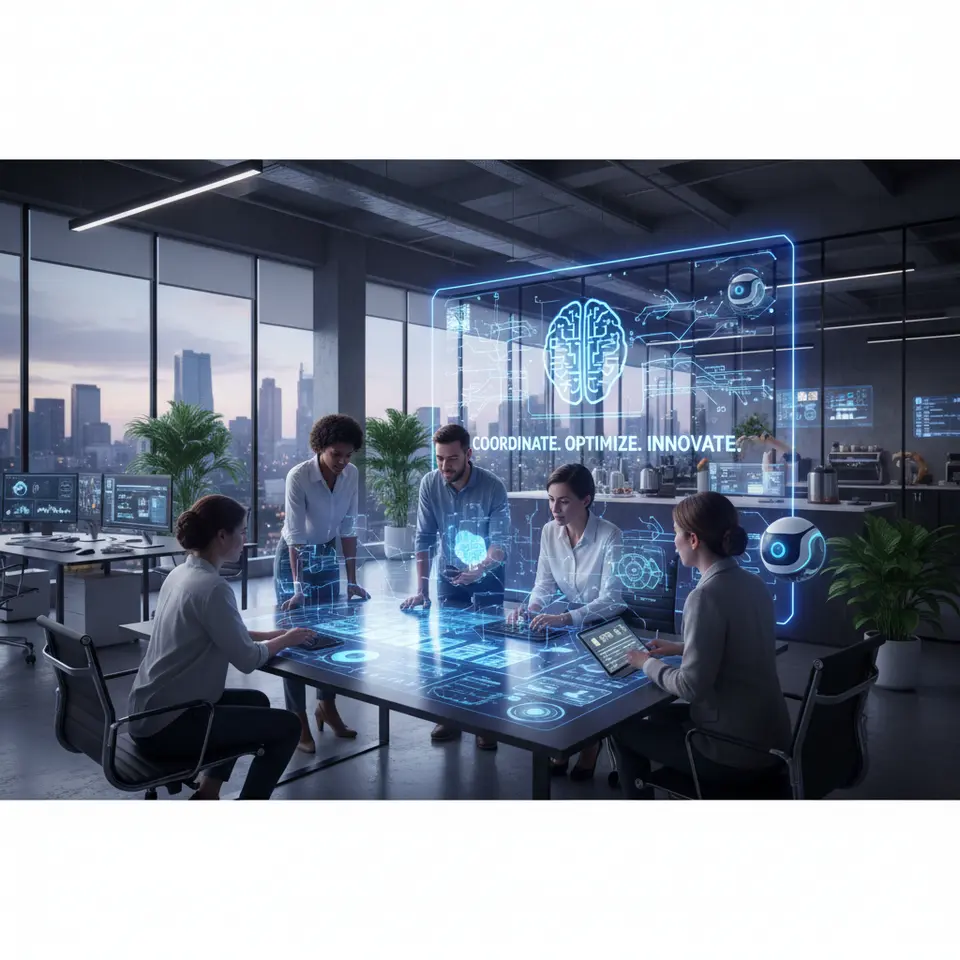
As businesses navigate increasingly complex environments, the priority for adopting AI technologies is evolving. Coordination-first approaches position AI as a central nervous system that harmonizes operations, which contrasts with early AI uses primarily focused on task replacement.
Research indicates that organizations adopting coordinated AI solutions report higher operational resilience and superior cost efficiencies. With platforms like AITechScope paving the way for AI-powered virtual assistance combined with workflow automation, the future points toward integrated intelligence boosting both productivity and workforce satisfaction.
For HR and tech companies, embracing AI workforce coordination translates to investing in tools that facilitate real-time data sharing, adaptive workflows, and cross-functional collaboration. This trend is supported by discussions on AI adoption gaps, reflecting the need for responsible and strategic AI implementation across industries (AI adoption reliance gap).
In conclusion, the big payoff for AI in 2026 and beyond is clearly in its ability to act as a coordination catalyst across enterprises—not just an automation replacement. This perspective encourages a more holistic integration of AI technologies that empower human workers and drive sustainable business growth.
For more insights on integrating AI tools into the workforce, explore our detailed analysis of AI tools transforming education and workforce and the cutting-edge developments in shadow AI and workflow disruption.
FAQ
Q: How does AI improve workforce coordination?
A: AI enhances workforce coordination by optimizing collaboration and facilitating intelligent task delegation among human workers.
Q: What are the implications of AI for HR professionals?
A: AI is viewed as a partner that augments HR decision-making, improving recruitment processes and employee engagement.
Q: How can companies implement AI for better productivity?
A: Companies can invest in tools that enable real-time data sharing and flexible workflows that integrate AI into their operations.
Q: What is the future outlook for AI in business?
A: The future emphasizes AI coordination capabilities, moving away from simple automation towards integrated solutions that boost resilience and efficiency.